
Blog
Beyond the Five Senses
The Incredible Ways in Which Animals Perceive the Environment Around Them
By Ryan Meczkowski · Licensed Naturalist Guide
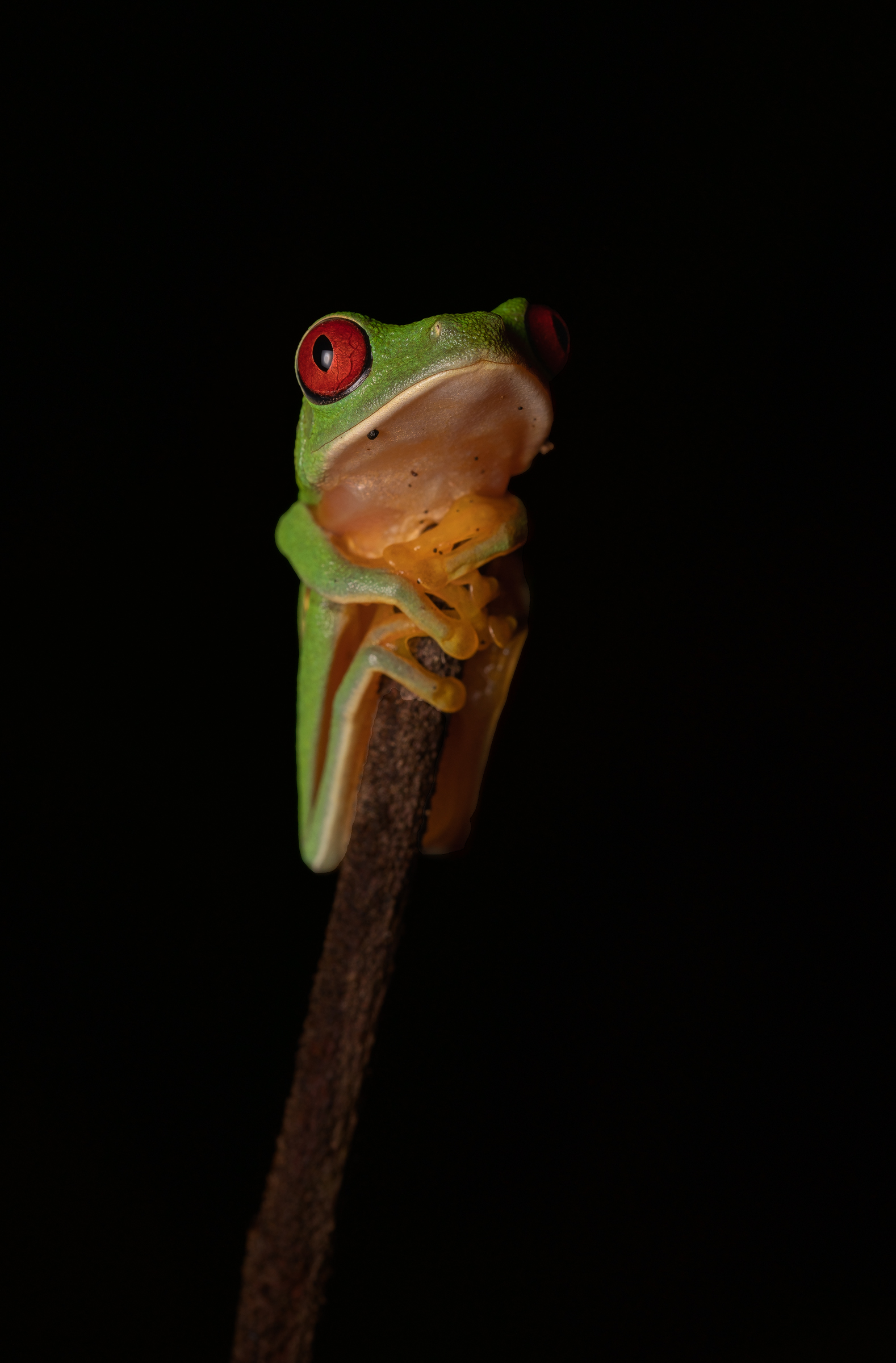
Often on a night tour, I ask my clients to turn off their flashlights and just listen to the sounds of the rainforest at night. During a new moon the darkness is just about absolute and the question arises as to how the animals we see on the tour are able to orient themselves in complete darkness. My answer is that they can do it quite easily by relying on specialized senses, unique to their specific species. For example, it is well-known that bats rely on echolocation by using a series of high-frequency sounds that reverberate off objects, providing information regarding location, size, and movement of the target. Pit vipers use specialized holes on their faces that allow them, through the use of infrared radiation, to detect body heat — kind of like the alien from the movie Predator. Tree frogs find their prey by using their super-sensitive feet to detect vibrations from insects moving around the plants in which they inhabit. And, while owls have large eyes to see well in the dark, they primarily rely on a unique hearing function to hunt. The facial disks, an iconic characteristic of the owl, function by funnelling sound to a set of asymmetrically-arranged ears, which allows for a microsecond delay when sound travels from one ear to the other, thus aiding the raptor in pinpointing the exact location of the source of the noise. Since humans rely primarily on sight, it makes it difficult for us to fathom that these animals can orient themselves as well in complete darkness, as we can in the middle of the day.
Unique sensory abilities are not exclusive to the nocturnal animals. For example, electric eels, as their name indicates, are capable of emitting electrical impulses that not only stun prey, but also act as a type of radar to help them navigate the murky waters of the Amazon Basin. And even more amazing, some animals can use the Earth's magnetic field to help navigate over large distances. Sea turtles from Costa Rica will undertake a large migratory loop that can take them to the Galapagos Islands, South America, even traversing the entire Pacific Ocean to Indonesia and the Philippines. After returning from these long odysseys, the females will rely on the Earth's magnetic field, imprinted on them at birth, to return to the exact same beach in which they were born to lay their eggs.
These are only a couple of examples of the many incredible methods in which animals are able to sense the environment around them. For a more detailed explanation of these systems, and how they have inspired the technology we use today, the book An Immense World by Ed Yong is not only an excellent read, but is full of fascinating information that provides a deeper respect and appreciation of the natural world. It reminds us that nature is the greatest innovator.